
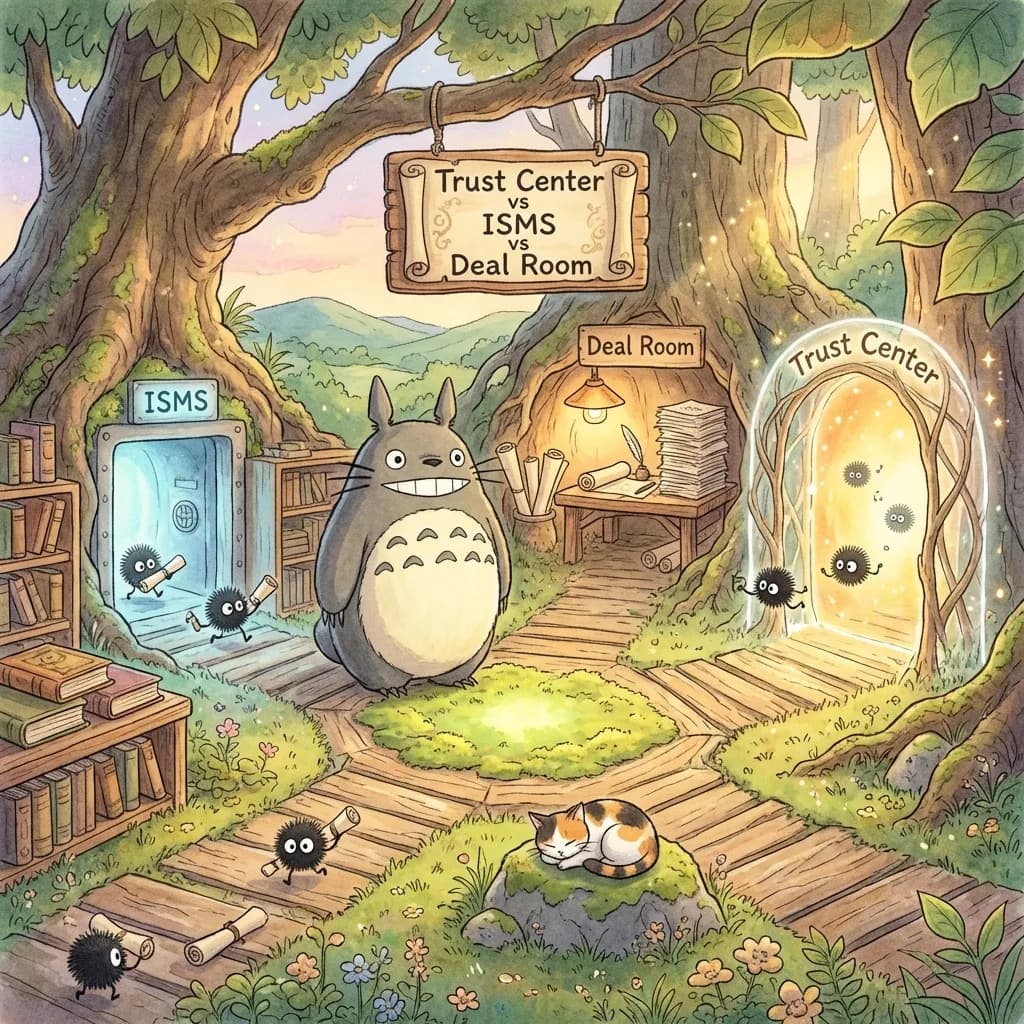
Trust Center vs. ISMS vs. Deal Room
Trust Centers, ISMS, and Deal Rooms serve different purposes. Learn how they compare, when to use each, and how they work together for modern B2B security and compliance.
Trust Center vs. ISMS vs. Deal Room
If you work in security, compliance, or sales at a B2B company, you've probably encountered all three: an ISMS that governs internal controls, a data room that sales uses to share documents during deals, and — increasingly — a Trust Center that makes your security posture visible to the outside world.
They sound similar. They overlap in places. But they solve fundamentally different problems, and confusing them leads to gaps in your security communication, duplicated effort, and slower sales cycles.
This article breaks down what each one does, how they compare across key capabilities, and how they complement each other.
Comparison at a glance
What is an ISMS?
An Information Security Management System (ISMS) is the backbone of your internal security governance. It's the structured framework — typically aligned to ISO 27001 — that defines how your organization identifies risks, implements controls, and continuously improves its security posture.
An ISMS covers:
- Risk assessments — identifying and prioritizing threats to your information assets
- Policies and procedures — documented rules for how employees handle data, access systems, and respond to incidents
- Internal audits — regular checks that controls are working as intended
- Continuous improvement — a cycle of plan-do-check-act to evolve your security program
The ISMS is essential. Without it, you don't have a security program — you have a collection of ad-hoc practices. But an ISMS is fundamentally inward-facing. It tells your own team what to do. It doesn't tell your customers what you've done.
What is a Trust Center?
A Trust Center is a centralized, customer-facing hub where you publish and control your security and compliance documentation. It's the external proof layer that sits on top of your ISMS.
Where an ISMS governs your internal controls, a Trust Center communicates those controls to the people who need to evaluate them: buyers, partners, regulators, and auditors.
A modern Trust Center includes:
- Public security profile — certifications, compliance badges, and a high-level security overview visible to anyone
- Restricted documents — SOC 2 reports, pentest summaries, DPAs, and subprocessor lists available to verified prospects
- NDA-protected content — architecture diagrams and detailed security controls for serious buyers
- Vendor register — a live view of your subprocessors and their compliance status
- Incident communication — a single place to announce security events, synced across all profiles
- Analytics — visibility into who's viewing what, which documents are downloaded, and where deals stall
The Trust Center doesn't replace your ISMS. It extends it outward.
What is a Deal Room (Data Room)?
A data room — sometimes called a deal room — is a file-sharing space used during sales or M&A processes. Sales teams upload documents (certifications, policies, contracts) into a shared folder and send the link to a prospect.
Data rooms are typically:
- Ad-hoc — created per deal, not maintained as a permanent resource
- Unstructured — a folder of PDFs rather than a curated security narrative
- Gated behind a single NDA — everything or nothing, with no layered access
- Limited in analytics — you might know if a link was opened, but not which documents were read or by whom
Data rooms solve an immediate problem: getting documents to a buyer during a deal. But they don't scale. Every new deal means a new folder, new uploads, and new manual effort. There's no single source of truth, no audit trail, and no way to update all recipients when a document changes.
When to use which
Use your ISMS to define and manage your internal security controls. It's the foundation everything else builds on.
Use a Trust Center to communicate your security posture externally. It replaces the repetitive email-and-PDF workflow with a permanent, updatable, access-controlled hub.
Use a Data Room for one-off, deal-specific document sharing when the content doesn't belong on your Trust Center — for example, custom contract terms or pricing proposals.
How they complement each other
The strongest B2B security programs use all three:
- ISMS provides the internal governance foundation — policies, controls, risk management
- Trust Center turns that governance into external proof — visible, searchable, and access-controlled
- Data Room handles deal-specific documents that don't fit the Trust Center model
Think of it as layers:
- The ISMS is what you do
- The Trust Center is what you show
- The Data Room is what you share on a case-by-case basis
When these three work together, security reviews happen faster, buyers self-serve the information they need, and your security team spends less time answering the same questions.
FAQ
Can a Trust Center replace my ISMS?
No. A Trust Center communicates your security posture — it doesn't define it. You still need an ISMS (or equivalent framework) to manage your internal controls. The Trust Center is the external-facing layer on top.
Can a Trust Center replace our data room?
For most security and compliance documents, yes. A Trust Center with layered access (public, restricted, NDA-protected) covers the majority of what sales teams currently share via data rooms. You may still need a data room for deal-specific documents like custom contracts.
Do I need all three?
If you're a B2B company going through security reviews, yes — in some form. The ISMS is non-negotiable for any serious security program. The Trust Center eliminates repetitive manual work and accelerates deals. The data room fills gaps for one-off sharing needs.
How does this relate to NIS2 and DORA?
NIS2 and DORA require organizations to demonstrate supply chain security and incident communication capabilities. An ISMS covers the internal governance side. A Trust Center adds the external proof and supplier oversight that regulators and customers increasingly expect. Data rooms aren't designed for regulatory compliance.
Ready to add the external proof layer to your ISMS? See how Orbiq's Trust Center works →